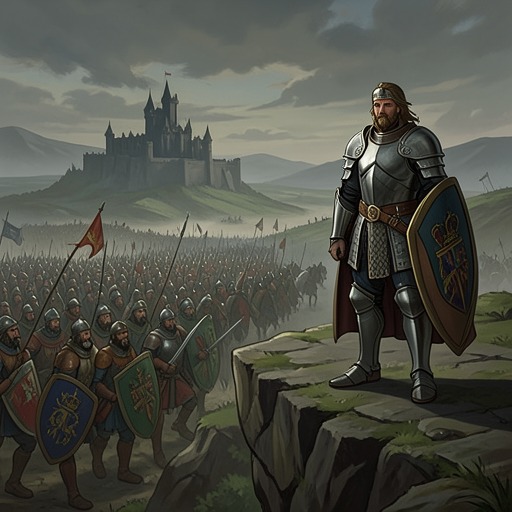
Henry V’s 1415 French campaign
Henry VKing Henry V’s 1415 French campaign converts a disputed inheritance claim into military action, while repeatedly testing the distance between a war declared lawful and the suffering it causes. Its course moves from argument over Salic Law to preparations for France, the siege of Harfleur, an exhausted army facing battle, and the killing of prisoners at Agincourt. The campaign’s significance lies not only in royal ambition or battlefield action, but in the play’s insistence that authority must answer for the lives spent in its name.
Claims and Commitment
Before the expedition, Henry asks his learned advisers to explain whether the Salic Law in France should bar England’s claim. The question is presented as a matter requiring both legal and religious judgment, not as a claim that settles itself. The debate makes the campaign’s stated basis visible: a dispute over succession must be examined before it can be turned into a royal undertaking.
That inquiry carries an explicit warning. Henry is urged to take care before committing himself and awakening the “sleeping sword of war”; the speaker invokes God and cautions that conflict between two kingdoms will bring bloodshed, including the blood of people who are not guilty of the quarrel. The warning gives the expedition a moral cost before it begins. The claim may be framed as rightful, but its consequences will fall far beyond the claimant.
Henry nevertheless presents his purpose as both vengeance and the assertion of a rightful claim, appealing to God as judge. The Dauphin’s insult is also part of the immediate dramatic setting: after the Tennis balls sent by the Dauphin, Henry says he hopes to make the sender blush. He orders his lords not to lose any favorable opportunity to advance the expedition, declaring France his present concern. The movement from insult to state action is swift, but the play does not let the insult replace the succession claim as the campaign’s stated justification.
Expedition and the Siege of Harfleur
The proposed scale of the undertaking is conveyed through an image of England divided into four, with one quarter taken into France. The language makes the expedition sound like a concentrated projection of national strength. Yet the stage cannot display an army and siege in their full extent. Chorus asks the audience to imagine the movement across the sea and the ordnance directed at Harfleur; the change of scene is completed through spectators’ thought as much as through theatrical action.
At Harfleur, the campaign becomes a siege with immediate physical stakes. The stage direction places Henry, several dukes, and soldiers carrying scaling ladders before the town. The Chorus’s imagined artillery gives way to the dramatic scene of an army at the walls. Captain Fluellen’s objection to going into the mines introduces a different aspect of military action: he says that the proposed approach does not accord with the disciplines of war. Even within an expedition urged forward by royal purpose, conduct and method remain matters for scrutiny.
Henry’s language to Harfleur is coercive. He threatens that the gates of mercy will be shut and that his soldiers will range with bloody hands, presenting violence as the consequence of continued resistance. The threat shows how the campaign’s claim to justice coexists with pressure on a besieged population. The text supplies the threat and the unfinished state of the siege, but this evidence does not establish the town’s eventual fate; its importance here is the stark warning used to demand submission.
Military Strain and Moral Responsibility
A message from Montjoy, speaking for the King of France, frames the French response in terms of patience and advantage: apparent weakness, he says, has been sleep rather than death, and advantage makes a better soldier than rashness. The exchange shifts attention from royal declarations to competing military calculations. The French have not simply disappeared from the conflict; they are waiting for an opportunity.
Henry acknowledges the condition of his own force. His people are much weakened by sickness, his numbers have fallen, and the few remaining soldiers are described as scarcely better than the French. This admission complicates the image of an England divided and carried into France in strength. The expedition proceeds under strain, with illness and reduced numbers shaping the danger faced by the army.
The question of responsibility also reaches the soldiers. Williams argues that, if the cause is not good, the king will face a heavy reckoning when the dead and mutilated bodies of battle are joined in judgment against him. His challenge brings the earlier warning about innocent blood into the army itself. The campaign’s justice is therefore not only a question for advisers or monarchs: the men expected to fight can question whether the cause warrants the bodily cost imposed on them.
Agincourt and the Cost of Victory
As the play turns toward battle, the Chorus describes a brief human contact with Henry during the night before the scene flies to combat. The phrase “A little touch of Harry in the night” compresses the contrast between the king’s public command and his presence among those who serve under him. It does not remove the difference in rank or responsibility; it makes the human dimension of leadership part of the approach to battle.
During the fighting, the French reinforce their scattered men. Henry responds with an order that every soldier kill his prisoners. A later explanation connects the order to the burning and carrying away of everything in the king’s tent, but that stated circumstance does not erase what the order requires: the killing of captives. The campaign thus brings its most severe contradiction into view. A war presented through law, divine appeal, and rightful purpose also produces a command against prisoners, placing military necessity and moral judgment in direct tension.
Across the campaign, royal argument, theatrical imagination, siege threats, battlefield hardship, and the prisoner order accumulate rather than resolve into a simple account of justified action. The claim to France supplies the expedition’s political rationale; the warnings, the diminished army, Williams’s challenge, and the executions expose the obligations and consequences that rationale cannot settle on its own.